
Another novel aging + disease program from Insilico has reached developmental candidate stage. I have written that line many times now, and I still do not take it for granted. Each time, it means the platform we spent years building did the one thing it was built to do — turn a question about biology into a real molecule. This one does something extra that I would not have predicted a couple of years ago: it walks us into a disease area we had never worked in before.
The candidate is ISM9077, a potential first-in-class inhibitor of a target I will call "Target Y" throughout, for competitive and IP reasons. We have nominated it as a Preclinical Candidate (PCC) for ocular diseases, with an initial focus on dry age-related macular degeneration (dry AMD), uveitis, and dry eye disease. It is our 7th Development Candidate of 2026 and the 32nd PCC we have nominated since 2021. Long-time readers know I do not lead with those counters to brag. They are the closest thing I have to an honest instrument for whether generative AI drug discovery is a repeatable process or a one-time headline. Thirty-two times, our platform has taken a biological hypothesis and produced a physical compound ready for the next stage. That is not luck. That is throughput.
But this program is not quite like the thirty-one before it, and that is why I wanted to write about it.
Why This One Is New Territory
Until this nomination, ophthalmology was not on Insilico's map. It is now. That matters for a company that has spent the better part of a decade building what I call a dual-purpose pipeline: programs aimed at a specific disease that also engage biology inside the aging process itself. Before ISM9077, that pipeline already spanned central nervous system disease, fibrosis, cardiovascular disease, metabolism, pain, cancer, and inflammatory bowel disease. Add ophthalmology and we now have dual-purpose programs across nearly every major axis of age-related morbidity. For a platform company, being able to say that at all is the whole point.
The commercial backdrop is not trivial either. The global ocular-disease market exceeded USD 40 billion in 2025 and is projected to reach roughly USD 71.58 billion by 2034. Uveitis alone — one of our three initial indications — accounts for more than 10% of severe visual handicaps in the United States. None of these are boutique problems. They are large, underserved, and many are still managed with approaches that have barely moved in years.
Here is the part that excites me as a scientist. Target Y had not previously been implicated in dry AMD or dry eye disease. Both are genuinely novel indications for this biology. Nobody had drawn a line from this mechanism to these two diseases until our team did the work and stood behind it. That is the kind of novelty I have argued for my entire career — not different for its own sake, but different because it opens a door nobody else was standing near.
Now the hard part. Target Y has no clinical proof of concept today. Our preclinical data are strong. But not one human being has yet been dosed and shown to benefit through this mechanism in these indications. This is early, deliberate, novel-target risk. A decade-plus of running a drug company has taught me that preclinical excitement and clinical reality are two very different conversations, and the gap between them is where most candidates quietly die. You should hear that from me now rather than infer it later.
The Science: One Molecule Designed to Do Several Jobs
ISM9077 is a dual-purpose, potential first-in-class "pipeline-in-a-drug" — a single molecule engineered to act across several related conditions through one shared mechanism, instead of demanding a separate compound per indication. It was conceived, scored, and refined inside Chemistry42, our generative chemistry platform. Regular readers know the workflow, and it still strikes me as remarkable every time: structure-based drug design anchored in our own structural understanding of the target, de novo generative design to reach into chemical space human chemists rarely explore, and an AI-driven, target-specific activity-prediction model to rank what the generators propose. Cycle after cycle of generation and optimization produced ISM9077 — a novel structure against a novel mechanism, with a favorable patent position and a chemical identity no one else has claimed.
In preclinical models, it performed beyond what I expected across three separate ocular indications:
- Dry AMD models — ISM9077 improved retinal structural integrity and visual function, with efficacy on key endpoints roughly three times that of a current therapy, plus superior histopathological improvement and gains on OCT retinal-thickness and ERG B-wave readouts.
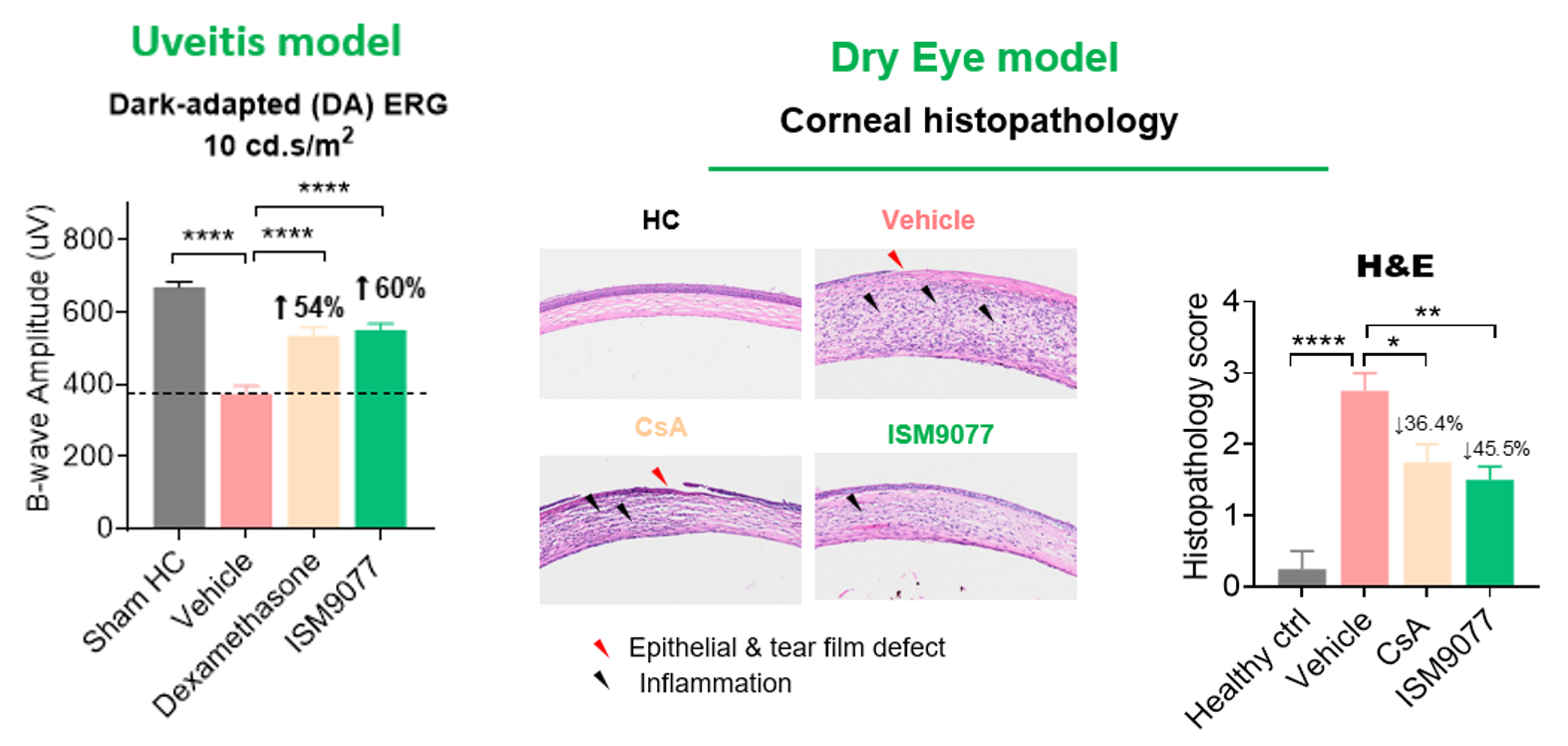
- Uveitis models — the compound lowered ocular inflammation, reduced inflammatory cytokine release, and restored retinal function.
- Dry eye models — it increased tear production and quieted corneal inflammation with a fast onset, outperforming Cyclosporine A (CsA), today's standard of care.
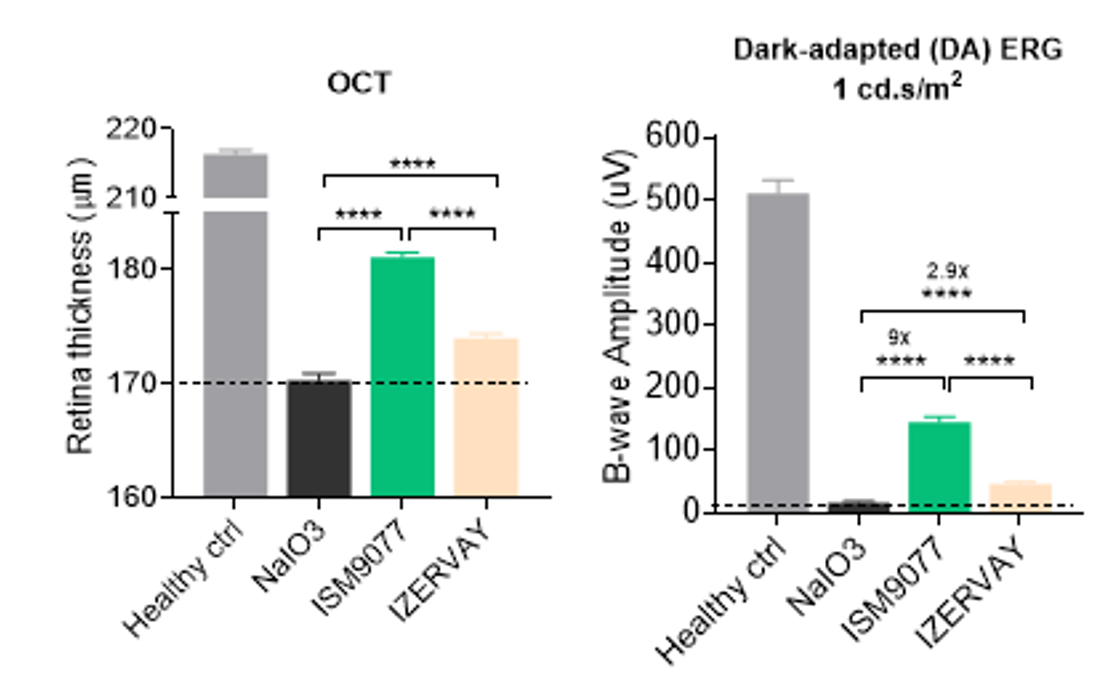
Alongside that efficacy, ISM9077 showed a favorable preclinical safety profile with a wide safety margin. These are preliminary, non-GLP findings, not a guarantee of anything. The molecule also has good permeability and notably strong retinal tissue exposure, reaching 2 to 5.5 times plasma levels — exactly the profile you want if the goal is a molecule that acts once it arrives at the eye rather than merely circulating past it. Paired with favorable oral bioavailability, that opens two development routes at once: an oral program and a topical eye-drop formulation. If both hold up, it would break from the frequent intravitreal injections that dominate advanced ocular-disease care today — a gentler experience for patients, if we get there.
The Aging Angle
I care about Target Y beyond its ocular markets because it sits inside the biology of aging itself. That is the dual-purpose thesis made concrete: a disease target that also lives in the machinery of why we grow old. It is the idea I keep circling back to in this newsletter, because I believe it is the most important structural insight in modern drug discovery — the pathways that drive specific chronic diseases are so often the same pathways that drive aging that a platform capable of drugging one frequently gets a shot at the other for nearly free.
Let me be specific about what the evidence does and does not say, because this is exactly the place where longevity science gets oversold.
In a published progeria mouse model (PNAS, 2025), pharmacological inhibition of a downstream signaling adaptor one step below Target Y extended median survival by approximately 26% — from about 120.5 to about 152 days — with improved body-weight maintenance, reduced aortic pathology, preserved adipose tissue, and enhanced mitochondrial function. Two caveats matter and I am not going to bury them: that experiment hit a downstream adaptor, not Target Y itself, and it was done in a disease model — progeria — not in normal aging. It is encouraging biology adjacent to our target. It is not a lifespan result for our drug.
There is a second, stranger line of evidence. Naked mole-rats — the longest-lived rodents we know of — carry evolved variants of this same target gene that enhance its DNA-repair function. Expressing those variants extends lifespan in flies and improves outcomes in mice (Science, 2025). I find this genuinely interesting, but I want to be careful: enhancing a DNA-repair function is mechanistically different from what a small-molecule inhibitor does when it dampens an inflammatory pathway. So I treat the naked mole-rat story as context about the target's deep role in aging biology, not as direct precedent for how our inhibitor works.
On the human side, a rare, reduced-function variant of the target gene has been found in multigenerational long-lived families. Early follow-up work in human cells links that variant to attenuated inflammatory signaling and delayed cellular senescence in carriers. This is an early, still-to-be-confirmed signal — moderate evidence, on our internal read, not established human proof. I mention it because it points in the same direction as the rest, not because it settles anything.
And here is the honest gap. Nobody has yet generated direct lifespan data from a target-specific pharmacological inhibitor of Target Y itself, tested in normal, non-disease-model aging animals. Every industry inhibitor of this pathway so far has been aimed at disease, not longevity. That experiment has not been run. It is precisely the experiment Insilico is well positioned to run next, now that ISM9077 has reached DC stage for a real disease indication. I would rather state the gap plainly and go close it than pretend it is already closed.
In Our Own Words
ISM9077 is our 32nd preclinical candidate since 2021, which makes it a concrete example of generative AI delivering at scale rather than in isolated flashes. It brings together a novel target, a molecule designed from scratch, and a novel formulation possibility in eye drops. Beyond a potentially non-invasive, highly effective option for the millions living with blinding ocular disease, it deepens our dual-purpose strategy — treating a specific disease while going after aging and healthspan at the same time — because Target Y is so tightly bound up with aging, longevity, and multiple age-related conditions.
— Alex Zhavoronkov, PhD
My colleague Feng Ren, our Co-CEO and Chief Scientific Officer, put the unmet-need side well. Ocular disease needs new options, because existing therapies have never balanced toxicity, efficacy, and adherence at the same time. ISM9077 tries to relieve some of those tensions through AI-driven structural design — strong target exposure and the potential for an eye-drop formulation. Dry AMD remains a leading cause of irreversible central vision loss in older adults, and the efficacy we saw in our therapeutic studies, including in Cynomolgus monkey models, is to our knowledge the first indication of this target's therapeutic value for dry AMD in a system much closer to human biology. Like Feng, I am eager to see what clinical translation reveals.
The Bigger Platform Story
Step back and ISM9077 is, at bottom, a story about speed. Traditional early discovery often takes 2.5 to 4 years to reach a preclinical candidate. Across our programs, we have repeatedly hit PCC nomination in an average of 12 to 18 months, synthesizing and testing only 60 to 200 molecules per program. That is not a fluke attached to one lucky project. It is the sustained output of an integrated system — PandaOmics for target identification and disease biology, Chemistry42 for generative molecular design, and the rest of Pharma.AI carrying candidates through the translational work that decides whether preclinical promise survives contact with real biology. Since 2021 that system has produced 32 PCCs, of which 13 have gone on to earn IND approval or clearance. ISM9077 is simply the newest point on that curve — and the first to plant a flag in ophthalmology.
I do not yet know whether Target Y will turn out to be a target that defines a decade. What I do know is that we could not have found it, designed a molecule against it, and carried it through three disease models on this timeline without the generative AI infrastructure we have spent years building. Whether or not this candidate clears the far higher bar of human proof of concept, the fact that we can make a bet this novel, this deliberately, on this schedule — and then do it again next quarter — is the point. That is what a working drug-discovery platform looks like in 2026: not one lucky molecule, but a system for placing calculated bets on biology no one else has dared to try.
Thanks for reading Forever.AI: AI, Robotics, Quantum, Longevity, Cryonics & BCI! Subscribe for free to receive new posts and support my work.
Note that this article was prepared using generative AI and may contain hallucinations, inaccuracies, and errors. Please do your own research. While the author is the CEO of Insilico Medicine, the statements and views presented in Forever.ai do not represent the views and opinions of Insilico Medicine.